2026 General Election: November 3 Official election information

Proposed plan

Flood Protection for District 23

A mauka to makai plan to protect our neighborhoods.

Flood protection begins in the mountains above us and continues through our streams, bridges, neighborhood drains, and the Ala Wai. I would pursue a coordinated plan that addresses underlying causes, protects residents, and makes maintenance and spending accountable.

The Ala Wai watershed connects Makiki, Mānoa, and Pālolo with neighborhoods downstream. Our response needs to consider both stream flooding and rainwater that overwhelms local drainage. Hawaiʻi Sea Grant describes how development increased runoff while the loss of wetlands removed natural water-storage and filtering functions. [1]

At a glance

Flood protection from mauka to makai

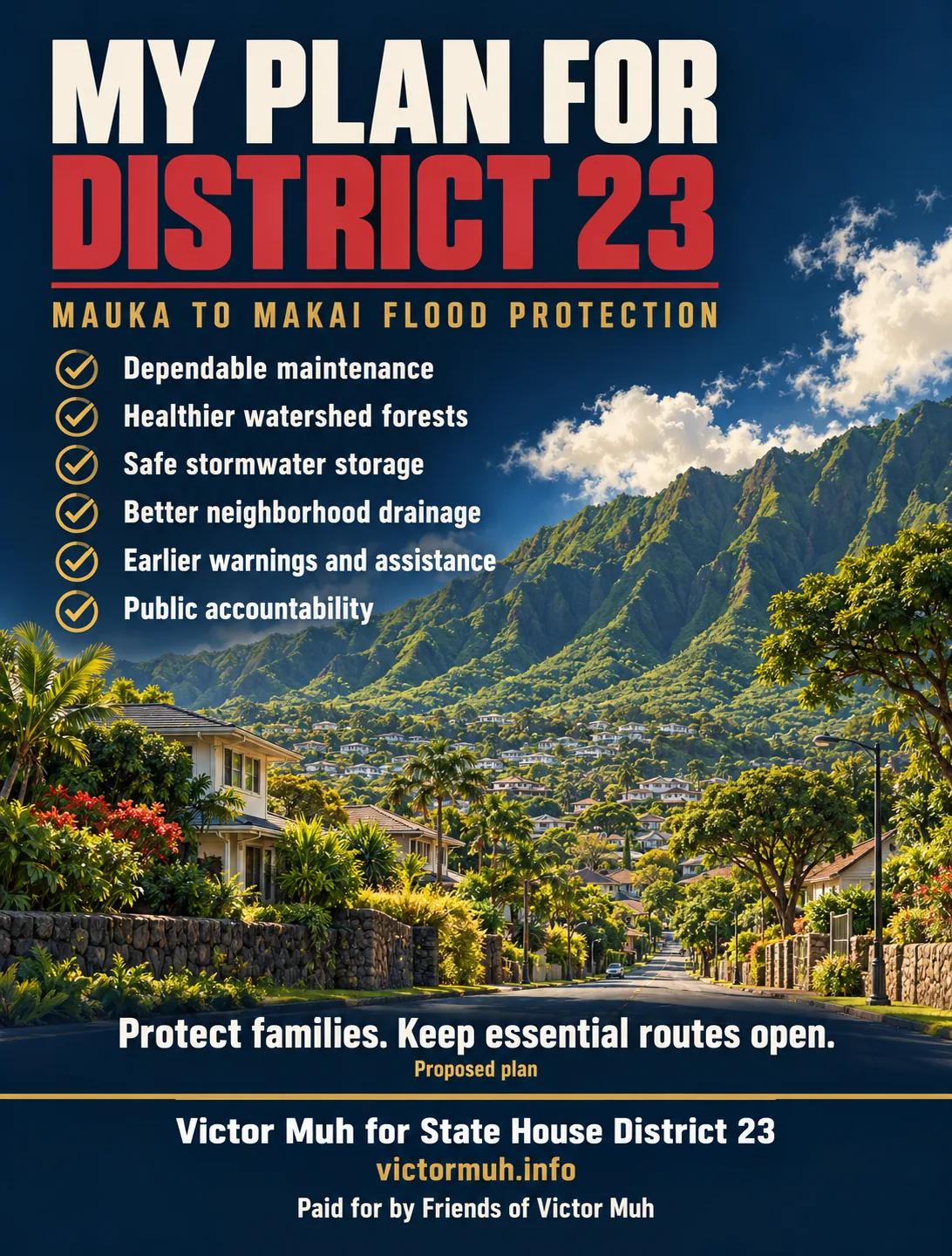
Campaign graphic summarizing Victor Muh's proposed six-part mauka to makai flood protection plan for District 23.
Summary graphic of the proposed six-part plan, including maintenance, watershed care, stormwater storage, drainage, warnings and assistance, and public accountability.
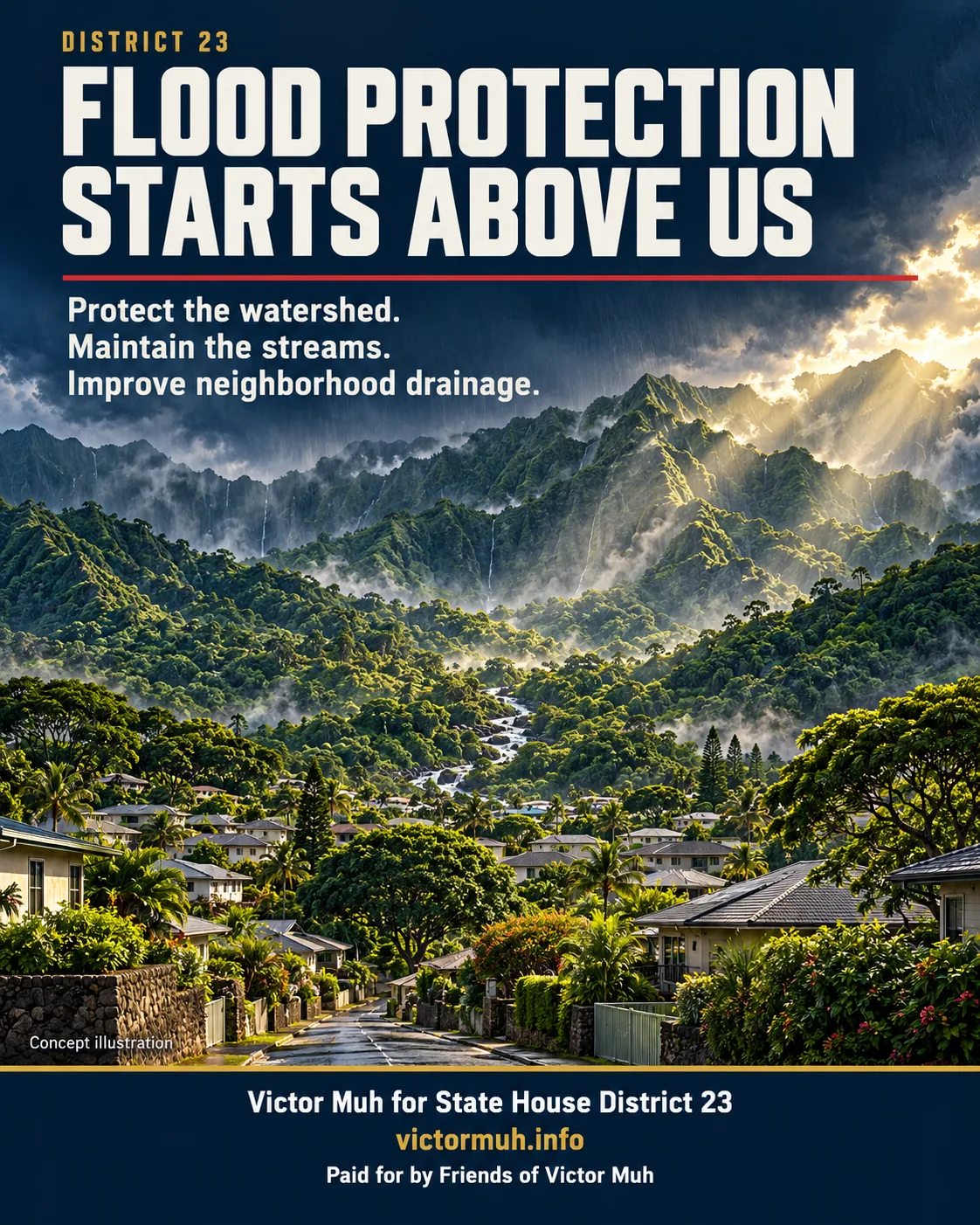
Campaign graphic stating that District 23 flood protection starts above us and highlighting watershed, stream maintenance, and neighborhood drainage.
Overview graphic framing the proposal from mauka to makai: protect the watershed, maintain the streams, and improve neighborhood drainage.
Campaign graphic about maintenance as flood protection, showing drain clearing and street-level maintenance work.
Maintenance graphic supporting the proposal to inspect streams, bridges, and drains, remove dangerous obstructions, and publish who is responsible.
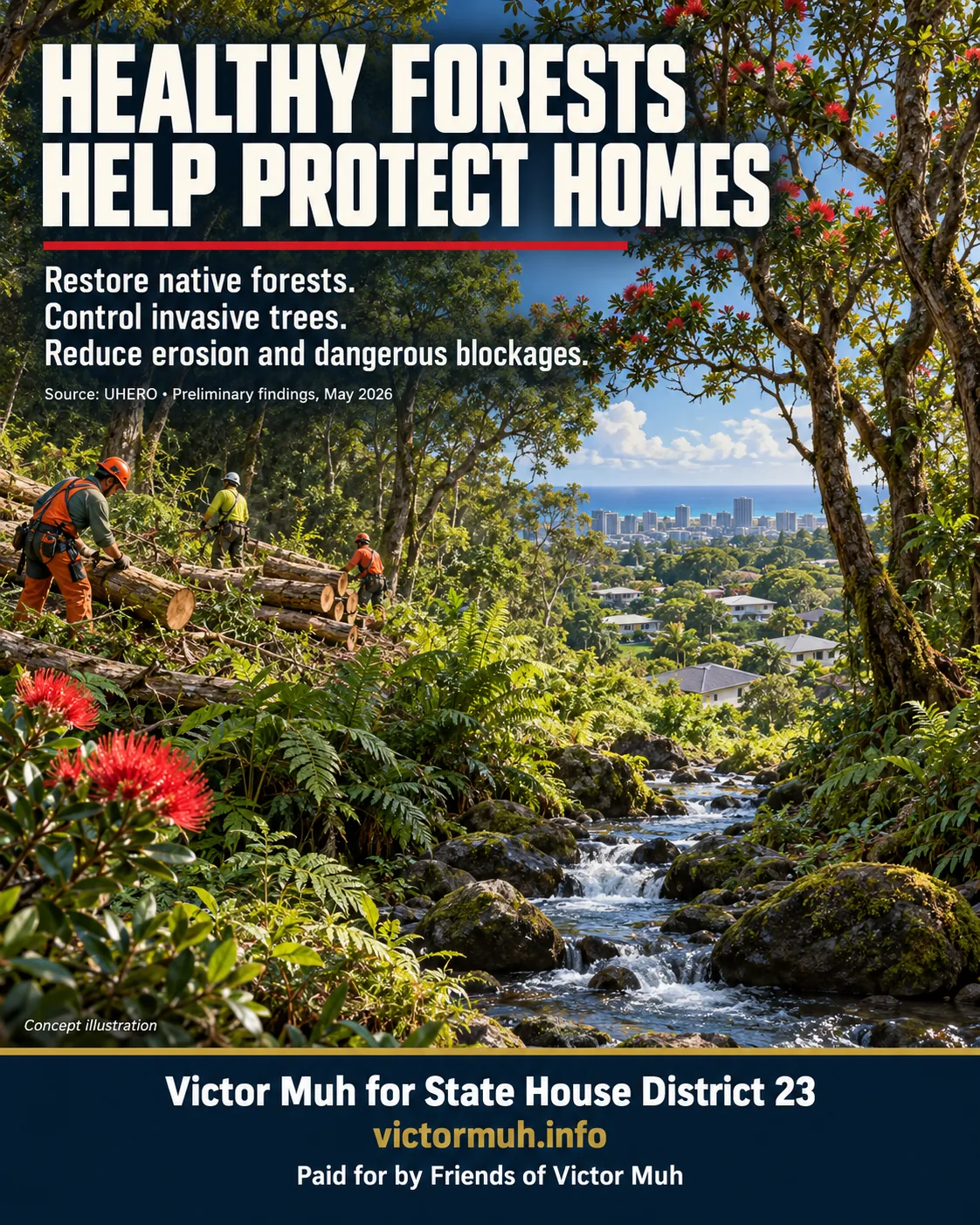
Campaign graphic about healthy forests protecting homes, showing upland forest work above neighborhoods.
Watershed graphic supporting the proposal to restore native forests, control invasive trees, and reduce erosion and dangerous blockages. It retains the UHERO preliminary-findings label.
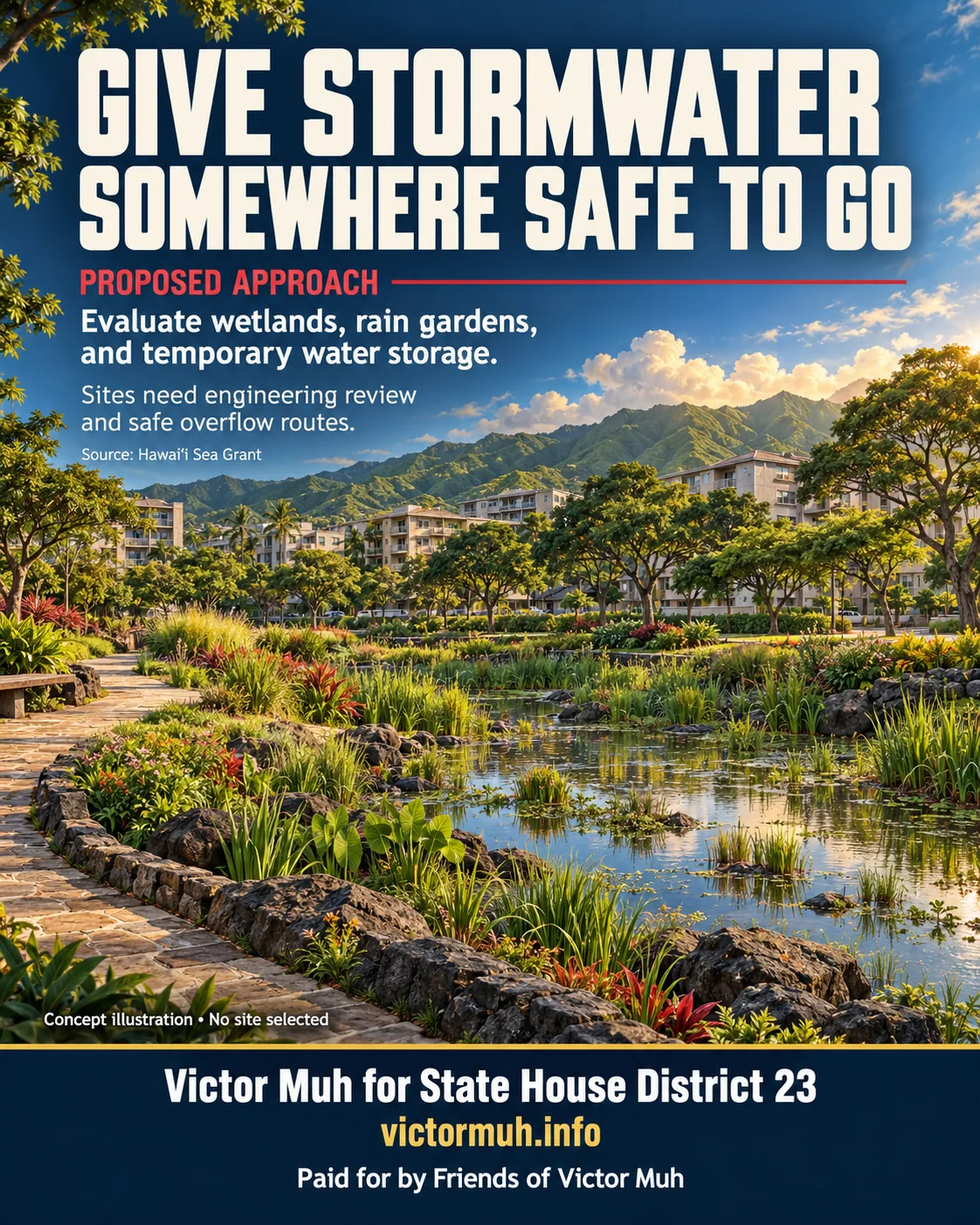
Campaign graphic about safe stormwater storage, showing a landscaped water feature and proposed wetlands, rain gardens, and temporary water storage.
Stormwater-storage graphic supporting the proposal to evaluate wetlands, rain gardens, and temporary water storage. It preserves the note that no site has been selected and that engineering review is needed.

Six priorities

Six priorities for District 23

1. Make maintenance dependable

I would bring the City, State, and affected landowners together to identify responsibility for each stream section, bridge opening, culvert, and drain serving District 23.

I would push for a published inspection and maintenance schedule, checks before forecast major storms and after damaging events, and prompt action on dangerous obstructions. Homes, schools, and emergency access should guide the priorities.

Maintenance should be targeted and informed by engineering and environmental review. Streambank stability and healthy vegetation also matter.
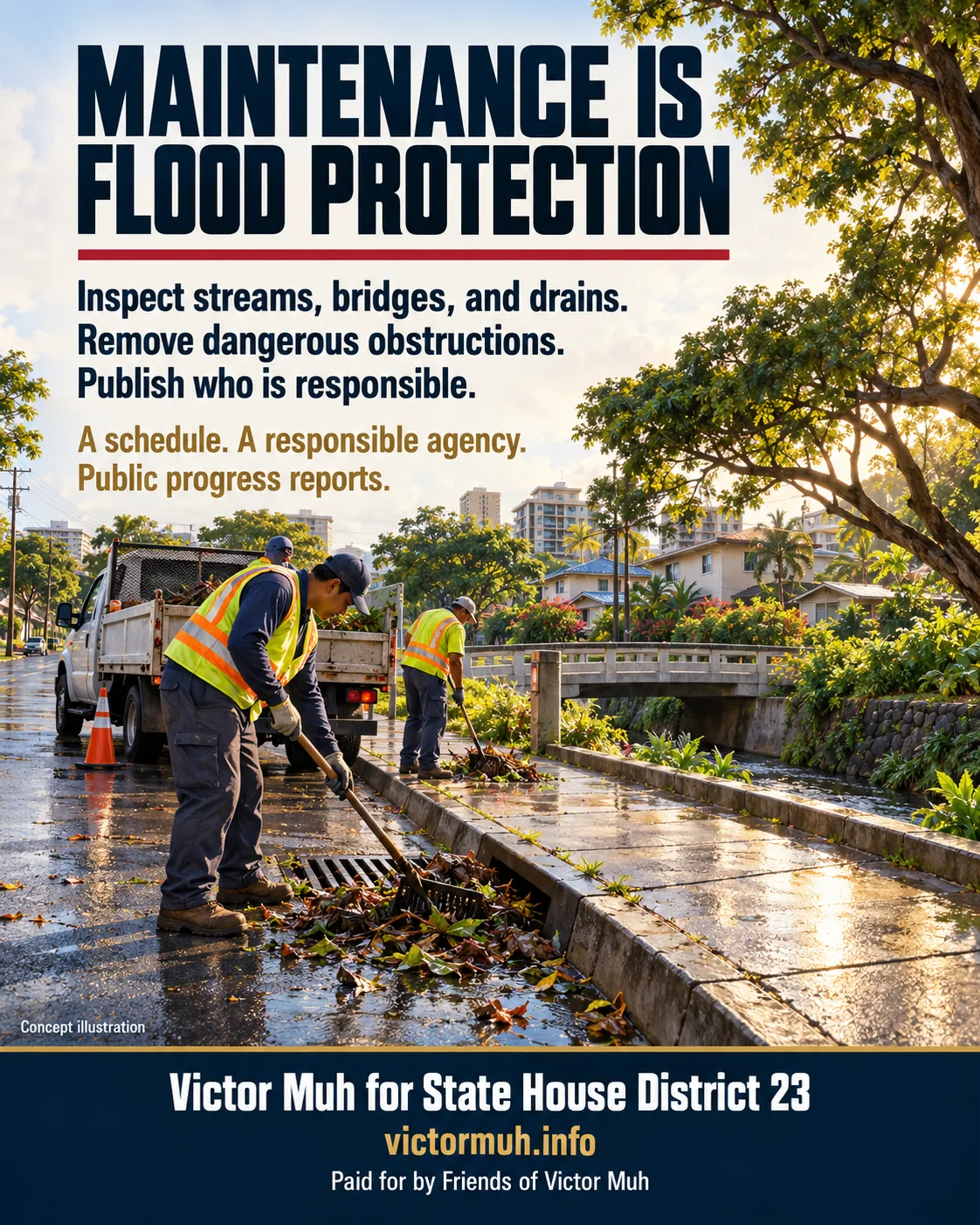
Campaign graphic stating maintenance is flood protection.
Campaign graphic used here as a visual summary of the proposed maintenance agenda.

2. Protect the watershed above us

I would support sustained funding for native forest recovery, erosion prevention, and targeted control of invasive species such as albizia and miconia.

UH researchers studying the Ala Wai watershed report that healthy native forests help slow runoff and stabilize soil. They also document how broken albizia limbs and trunks can obstruct streams. Their preliminary findings support including watershed care in flood planning. [2]

Removal work should include appropriate restoration and erosion control, with progress measured over time.

Campaign graphic stating healthy forests help protect homes.
Campaign graphic used here as a visual summary of the watershed-protection proposal.

3. Give stormwater somewhere safe to go

I would seek an assessment of suitable public land, parks, parking areas, and other properties for temporary stormwater storage. Options could include landscaped detention areas, underground storage, rain gardens, and restored wetlands.

Wetlands can collect and slow water while allowing sediment to settle. Traditional loʻi kalo systems connect streams with cultivated terraces through irrigation channels called ʻauwai. [3]

I would also pursue a demonstration project with Native Hawaiian practitioners to assess whether a suitable site could combine traditional water management, food production, education, and measurable stormwater benefits. Any participating organization would help shape the project through consultation.

Locations would be selected only after evaluating soils, groundwater, available storage, water quality, safe overflow routes, landowner consent, and maintenance needs. Food-growing areas would require water suitable for that use.

Campaign graphic stating give stormwater somewhere safe to go.
Campaign graphic used here as a visual summary of the stormwater-storage proposal.

4. Improve neighborhood drainage

I would request a joint assessment of recurring flooding in McCully–Mōʻiliʻili and affected District 23 areas of Makiki. It should identify whether each problem comes from overflowing streams, blocked or undersized drains, or outlets affected by high receiving-water levels.

Repairs and upgrades should be ranked by the protection they provide to residents, emergency access, and their lifetime cost. Engineering review should show how each project affects upstream and downstream neighborhoods.

5. Improve warnings and assistance

I would seek an assessment of gaps in rainfall and stream monitoring, neighborhood alerts, road-closure procedures, and evacuation assistance.

Ground-floor households, kūpuna, people with disabilities, schools, and businesses with repeated flood losses should help shape the response. Where appropriate, I would pursue assistance for practical building protections.

6. Make responsibility and results public

As a state representative, I would use budget proposals, legislative oversight, and coordination with City and federal partners to advance this work.

Every proposed project should identify its responsible agency, expected benefit, estimated cost, maintenance owner, and source of continuing operating funds. Residents should be able to see what is funded, what is finished, and what is delayed.

I would seek an early joint agency briefing and public inventory of trouble spots, followed by a prioritized work program and quarterly progress updates. Maintenance, watershed restoration, and construction should have clear budgets and reporting.

Learn from Hawaiian knowledge and measure what works

Native Hawaiian communities developed connected agricultural water systems and organized their maintenance. At Kānewai in Mānoa, the university documents an ʻauwai system that predates the monarchy and was revived after ancient remnants were rediscovered in the early 1980s. [4] Hui Mālama ʻAuwai o Nuʻuanu describes shared responsibility for cleaning and repairing irrigation channels. [5]

These practices offer useful principles for water stewardship. Their flood benefits depend on site conditions and available storage. Restoring loʻi or forests alone cannot guarantee protection from extreme storms; modern drainage and engineering must be part of the plan.

Our goal is practical: protect families, keep essential routes accessible, and maintain the systems our neighborhoods depend on.

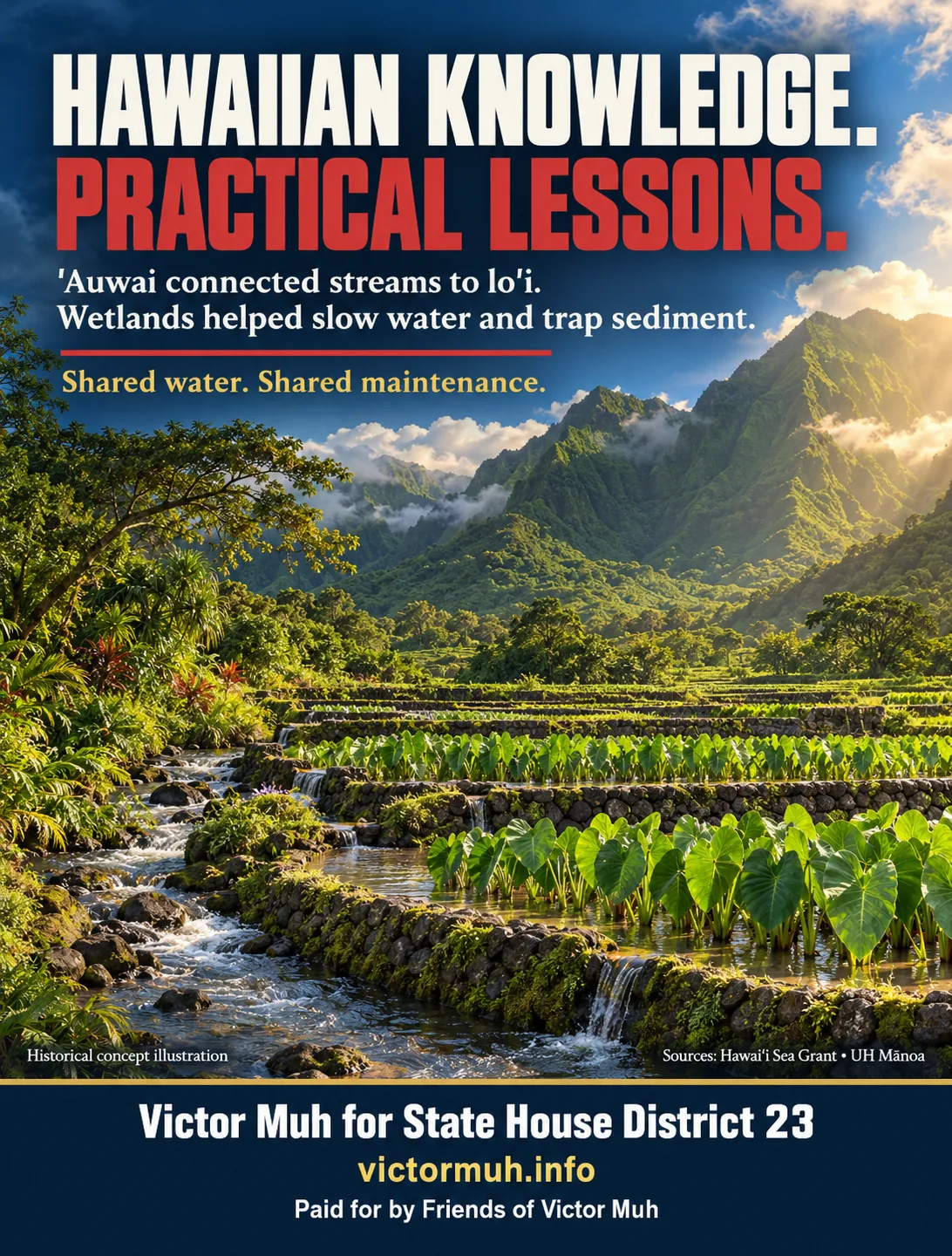
Campaign graphic about Hawaiian knowledge and practical lessons, showing loʻi and ʻauwai with the message shared water and shared maintenance.
Campaign graphic used here as a visual summary of the page’s Hawaiian-knowledge section. The page text still notes that modern drainage and engineering must be part of the plan.

Share a flooding concern

Tell the campaign where flooding recurs, when it happens, and which homes, businesses, or routes are affected. This contact form is for policy input. For an immediate emergency, call 911.

Share a flooding concern